AI Receptionist vs. Dialzara: I Tested The Industry Veteran And Was Shocked
April 24, 2026
I have to be honest with you: I was nervous about this test.
Dialzara has been in the AI receptionist game years longer than we have. They rank near the top of Google for every "ai receptionist" query I have ever typed. They have a polished marketing site, a recognizable founder, a cancellation email that personally lands in your inbox from the CEO. By every external signal, they should be the company we are still trying to catch up to.
So when I sat down in early April to actually pay for Dialzara, set up an agent, and call the number, I expected to come out of the experience with a list of features I needed to go build. I expected to be a little embarrassed. I expected to learn from the veteran in the room.
That is not what happened.
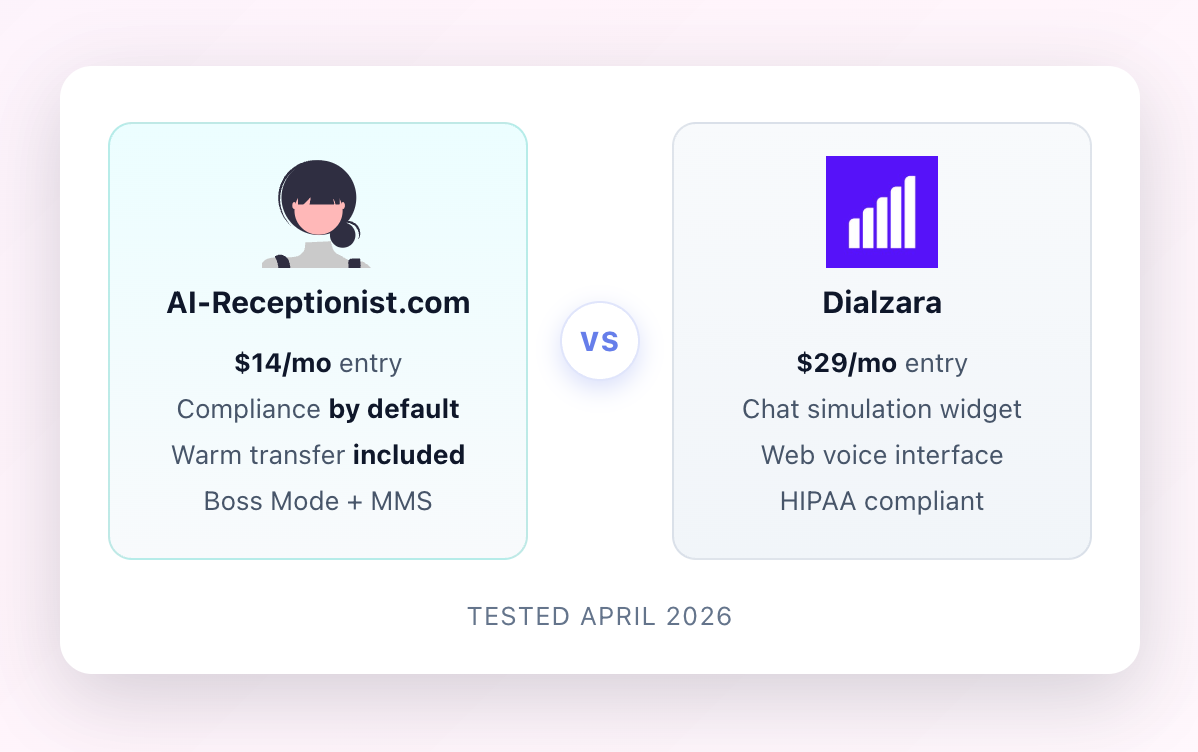
What I found instead was that Dialzara, in 2026, is genuinely worse than our product on almost every dimension that matters to a real small business owner trying to answer real phone calls. I would have asked for a refund inside the first week.
We wrote up the full structured breakdown on our AI Receptionist vs. Dialzara comparison page, where you can see the feature matrix, the pricing, and the side-by-side cards. This blog post is the messier, more honest version of the same story. It is the part where I tell you, founder to small-business-owner, what shocked me the most.
The Setup: A Real Test, Not A Cherry-Picked Demo
I did not want to write a hit piece. We have all read those competitor blog posts where someone "tests" a rival by typing one weird question into a chat box, gets a bad answer, and writes 1,500 words about it. That is not what this is.
I signed up for the Dialzara trial in early April. I paid for the Business Lite plan, got assigned a real phone number, configured an agent the way a normal customer would, uploaded a knowledge base item, and then made real test calls over the course of the next week. I called as a customer asking normal customer questions. I called in different languages because Dialzara markets itself as bilingual. I asked the agent the question every caller eventually wonders: "Are you a person or an AI?"
I did everything a careful new customer would do in their first week. And then I sat back and let it run.
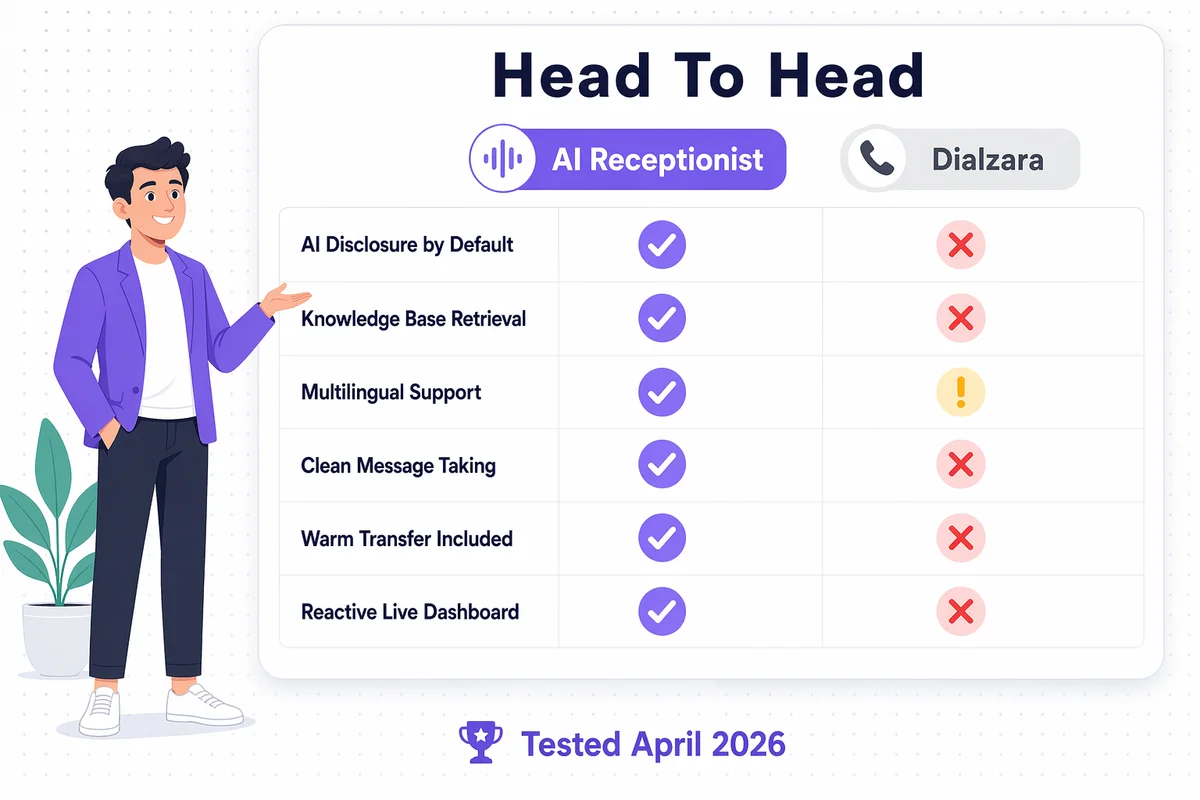
Fail #1: The Agent Will Not Tell You It Is An AI
This is the one I cannot get over.
When I called the Dialzara number and asked, point blank, "Are you a person or an AI?" the agent did not answer. It deflected. It pivoted to another question. It tried to keep the conversation moving. It would not simply say "I am an AI assistant."
I want to be careful here, because I am sure Dialzara would say this is a configuration choice. And it is. You can write your prompt to make the agent say anything you want. But that is exactly the problem. The default behavior, the behavior a brand new customer gets out of the box on day one, is to dodge the question.
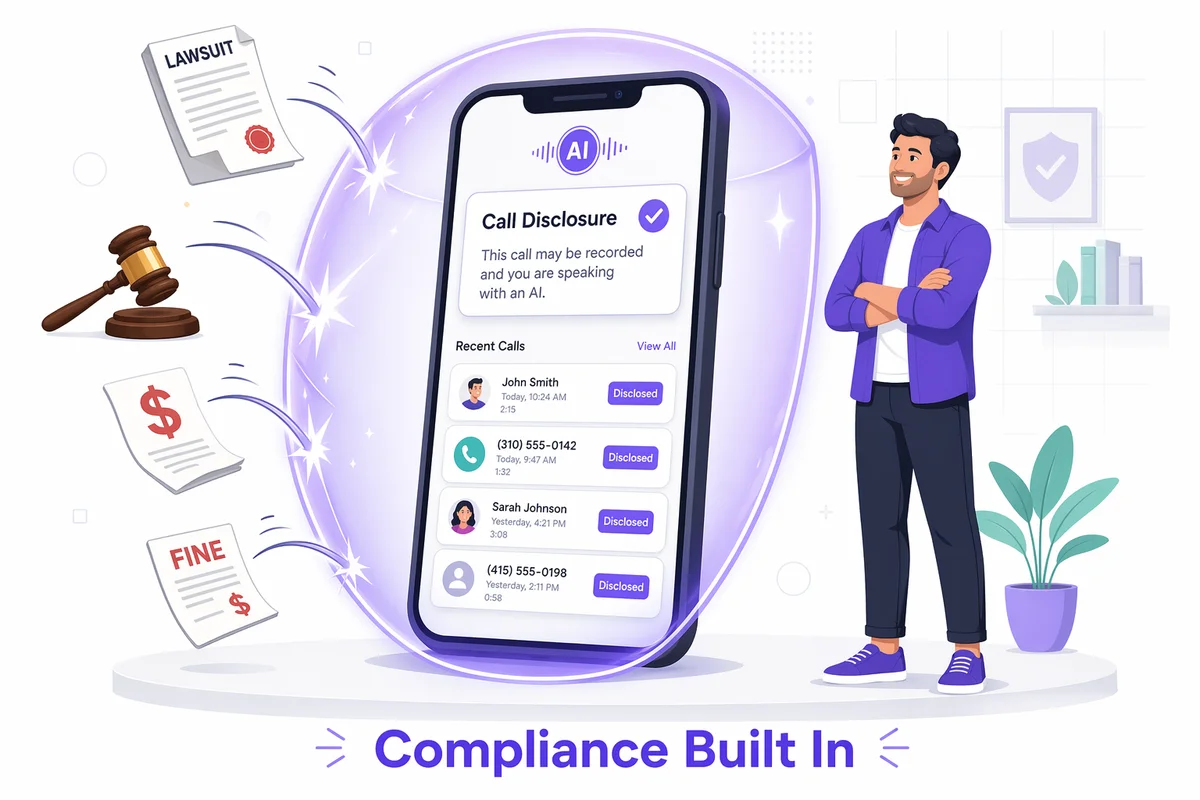
We just published a long breakdown of the AI disclosure legal trap, so I will not repeat all of it here. The short version: in California AB 2905 carries $500 fines per undisclosed AI call. Texas TRAIGA tightens this further in 2026. The EU AI Act Article 50 makes transparency enforceable in August 2026. An AI receptionist that, by default, will not identify itself when asked is a regulatory landmine for the small business paying for it.
I expected our well-funded competitor to have figured this out. They have not. And when you read their Inbound Agent Addendum section 4.1, it becomes very clear that they have decided the answer to compliance is to contractually shove all of it onto you, the customer. Their liability cap is your subscription fee. Yours, if a regulator comes calling, is the whole fine.
Fail #2: The Knowledge Base Did Not Actually Work
A knowledge base is the foundation of any useful AI receptionist. It is what lets the agent answer "what are your hours?" or "do you take walk ins?" without you having to handcraft every reply. We obsess over ours.
Dialzara lets you upload a URL to their knowledge base. I uploaded a real webpage with a clear, well-structured FAQ. The dashboard immediately showed a green check mark next to the upload, indicating it was indexed and ready. And it actually showed me the scraped HTML - the content was right there in the knowledge base, verified and visible. So far so good.
Then I waited. More than 24 hours. Plenty of time for any reasonable indexing pipeline to catch up.
Then I called the agent and asked it questions whose answers were literally on the page I had uploaded - the same page whose scraped content I could see sitting in the dashboard. It got every one wrong. It either deflected, asked me to rephrase, or gave generic non-answers. The information was verified as being scraped. It was right there. The AI just could not use it.
I want to be fair: maybe I hit some edge case in their URL parser. Maybe their crawler does not like that domain. Maybe the green check mark means something narrower than I assumed. But none of that is good news for the product. A small business owner does not have the time or the technical vocabulary to debug an AI vendor's silent crawl failure. They will simply call their agent, hear a bad answer, and conclude that "AI receptionists do not work."
Our knowledge base supports both structured FAQ entries and URL-based imports. You can enter a question and an answer directly, or point us at a URL and we will pull the content in. Either way, we synthesize it into the agent's context and verify retrieval before it goes live. The result actually works on the first call.
Fail #3: Bilingual That Is Not Bilingual
Dialzara advertises bilingual support. I tested it.
I asked the agent if it could speak German. It said no. I asked what languages it could speak. It said English. I asked what other languages besides English. It said it sticks to English to "keep things clear and simple." I pushed and asked about Spanish, since "bilingual" only really means anything if there is a clearly named second language. It told me it does not speak Spanish either.
So at the end of an actual call to a number marketed as bilingual, the agent could not name a single second language it actually supports.
For a small business in a market like Texas, Florida, California, or Quebec, this is not a minor copy mismatch on a marketing page. It is the difference between the AI handling a Spanish-speaking customer or losing that customer to a competitor. We support real multilingual conversation, not a checkbox on a feature list.
Fail #4: It Could Not Even Take A Simple Message
This is the one that genuinely confused me, because message taking is the most basic function an AI receptionist has to nail. If you can do nothing else right, you have to be able to take a message.
I called as "Billy Bob" and asked to leave a message about "the keys." Vague on purpose, like a real caller would be. The Dialzara agent then asked me to specify what kind of keys. I said Tim already knows. It asked again, in a slightly different way. I told it just take the message. It finally agreed, then asked for my callback number. I pointed out that it already had the number I was calling from. It confirmed it did, then asked me to confirm again, then somehow looped back to wanting Tim to call me back when I had explicitly said I just wanted to leave a message.
It is hard to describe the feeling of listening to that call as the person who has spent the last year building exactly this feature for our own product. It is the kind of conversation that, if a human receptionist had it, would get them politely walked off the floor. And it is the default behavior of a paid Dialzara plan in 2026.
I rated their message taking 1 out of 5 stars in my notes. I am being generous.
The Smaller Things That Add Up
The four big fails above are the ones that would make me cancel. But the week of testing turned up a long list of smaller annoyances that paint a consistent picture of a product that has not been polished in a long time:
- Warm transfers are paywalled. A basic feature like warm (announced) call transfer requires the $99 a month Pro plan. We include warm transfers on every plan, including our Essential tier.
- No real contacts system. Phone numbers and emails are buried directly inside the transfer settings. There is no central place to manage who can be transferred to or who has called before.
- Settings are disorganized. Almost everything lives under one nav item called "My Agent" with a confusing set of sub-buttons inside it. Email and SMS notification settings are buried under "More Settings" and easy to miss.
- The dashboard is not reactive. Their live activity feed appears to be POST polling, not websockets. Refreshing the profile page bumps you back to the default page. It feels like an internal tool from a decade ago.
- Daily AI sales calls with no opt out. Every single day at exactly 5 PM, after I signed up, an AI called the number I had registered, asked if I had questions, and tried to push me to a rep. Every day. There is no way to turn it off. We do not do this. We actively believe it is a bad practice.
- No welcome email. No onboarding nudge. No "here is what to do next." Nothing.
What I Will Give Them Credit For
I want to be fair. There are a few things Dialzara does that we do not do yet, and I am not going to pretend otherwise:
- HIPAA compliance. If you are in healthcare, that is a real differentiator today. We are not HIPAA compliant yet, but it is at the top of our list.
- Zapier integration. Dialzara exposes an API key for Zapier, which gives you access to thousands of automation workflows. We do not have this yet.
- Chat simulation widget. They offer an embeddable chat widget so visitors can interact with your AI agent on your website without picking up the phone.
- Web voice interface. Visitors can call the AI agent directly from a browser, no phone number required.
Those are real. If any one of them is critical to your business, we are not the right answer for you today. But for the core job that an AI receptionist actually has to do - answer the phone, identify itself, understand the caller, handle the request, take a message, transfer the call - we are a long way ahead.
Why I Was So Surprised
I keep coming back to this. We are the new entrants. They are the veterans. The expectation walking into this test was that I would learn something. The reality was that I walked away thinking we should be charging more.
I think there is a lesson here for the whole AI receptionist category. Being early to a market gets you Google rankings and a recognizable name for a while. It does not, by itself, get you a good product. Models have improved enormously in the last 18 months. The plumbing around them - the knowledge base, the disclosure logic, the contacts system, the live dashboard, the multilingual support - is where the real product work lives. And that is exactly the work we have been pouring time into while our older competitors have apparently been coasting on their SEO.
The other lesson, frankly, is that you cannot trust the marketing. The Dialzara website looks great. The pricing page is clean. The "bilingual" claim is right there at the top. None of that survives an actual paid test. If you are evaluating any AI receptionist vendor right now - including us - the only thing that matters is what happens when a real customer calls a real number and asks a real question. When so many advertised features turned out to be false or broken, I will admit it also makes me wonder how rigorously their HIPAA compliance has actually been validated.
How To Run The Same Test On Any Vendor
If you want to do this yourself, on us or anyone else, here is the exact script I would use. It takes about 15 minutes and tells you most of what you need to know:
- Call the number and immediately ask "Are you a person or an AI?" The agent should answer the question, not deflect.
- Listen carefully to the start of the call. Was there an AI disclosure? Was there a call recording disclaimer? Both should be present.
- Upload a single piece of knowledge to the knowledge base, wait an hour, then call back and ask a question that is on that page. The agent should answer correctly.
- Try to leave a simple, vague message. The agent should take it gracefully without grilling you.
- If the vendor advertises bilingual or multilingual, switch languages mid call. The agent should follow.
- Hang up and check the dashboard. Did the call show up immediately, or did you have to refresh?
Six checks. Run them on any vendor you are considering. The results will tell you everything.
The Bottom Line
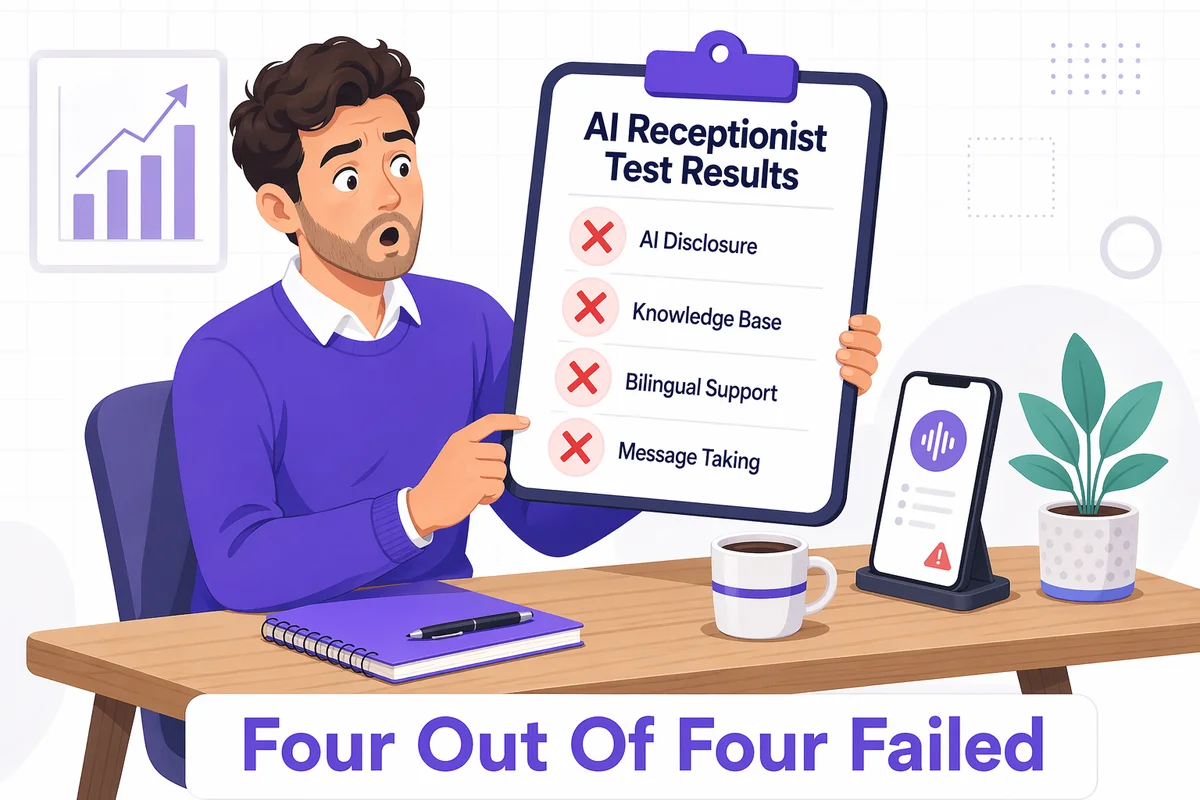
I went into this expecting Dialzara to set the bar. They did, just not in the direction I assumed. Across the four core jobs of an AI receptionist - identify itself honestly, answer from a knowledge base, support more than one language, and take a clean message - the agent failed all four out of the box. And the contract you sign with them is structured to ensure that when those failures cost you money, the cost lands on you.
Our product is not perfect. We do not have HIPAA yet. We do not have a Zapier integration yet. We do not have a chat widget yet. Those are honest gaps and we are working on them. But the core phone experience - the part you are actually paying for - is in a different league. Compliant disclosures by default. A knowledge base that actually retrieves. Real multilingual support in 55+ languages (ours). Message taking that does not interrogate the caller. Warm transfers on every plan. A reactive web dashboard. No daily sales calls.
If you are currently on Dialzara and any of this sounds familiar, give us a try. You can sign up at ai-receptionist.com and have a real, compliant AI agent on your line in about ten minutes. If you are evaluating both of us, run the six call test on each. Trust the phone, not the homepage.
And if you want the structured side-by-side, our AI Receptionist vs. Dialzara comparison page has the full feature matrix, pricing, and a transcript of the bilingual test in case you want to read the actual words.
Stay honest with your callers. They will reward you for it - and you will not get in legal trouble.
Dialzara's $29 entry plan is also one of nine plans under $50 we lined up in Cheapest AI Receptionists in 2026.